Human-in-the-loop risk review: how the scanner is meant to be used
How to use: this page describes the intended use of the P-01 scanner: a person reviews a skill's high-risk findings before the skill is enabled. The instructor asked for it in the Sprint 1 feedback ("define the final human-in-the-loop risk-review workflow that will use the scanner's results"; see docs/sprints/sprint-2/instructor-feedback.md, F5). Status: draft for team review (2026-10-16). It is a design. The pipeline today scans the GitSkills sample in batch, and no single-skill review tool is built. Regenerate the diagrams with python scripts/make_workflow_diagrams.py.
1. Why a person stays in the loop
- A skill is "copied like code and read like instructions" (
THREAT_MODEL.mdsection 1). Users usually do not read every skill before an agent uses it (section 2), and the agent acts on the skill with the user's permissions (boundary 3). - A rule match is a signal, not a verdict: it does not mean the skill is malicious or that the agent will act on it (
THREAT_MODEL.mdsection 6). Many matches are benign in context. - So the scanner should not block or allow skills on its own. It narrows a skill down to the few lines worth a person's attention, and a person makes the decision.
2. Actors
| Actor | Role in the workflow |
|---|---|
| Developer | Proposes adding a skill to a repository or enabling it for an agent: a new skill, or a copy of one from elsewhere |
| CI pipeline («system») | Runs the scanner when a pull request adds or changes a skill |
| Security reviewer | Triages each high-risk finding and approves, blocks, or asks for a change |
| Skill author | Revises the skill when a change is requested |
| Rule maintainer | Turns false positives into rule-change proposals |
In a small team one person can hold several roles, but the reviewer should not be the developer who proposed the skill, the same separation the repository uses for pull-request review.
3. Use case diagram
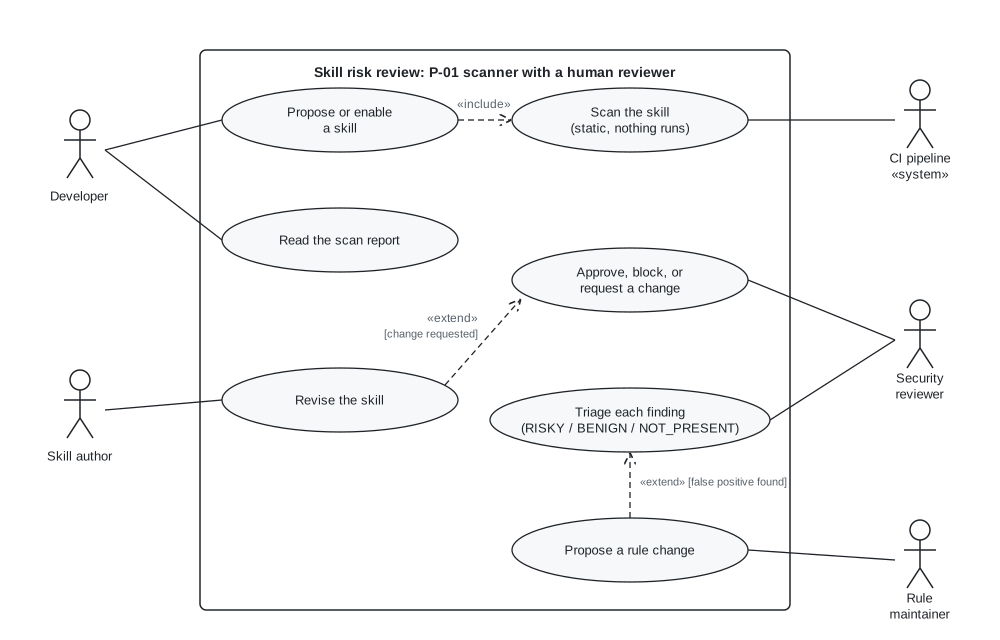
| Use case | Actor | Notes |
|---|---|---|
| Propose or enable a skill | Developer | Always includes a scan («include») |
| Scan the skill | CI pipeline | Static only: SKILL.md and bundled scripts are read as text and matched against rules/skill_risk_rules.yaml. Nothing is executed, imported, or fetched |
| Read the scan report | Developer | Rule, category, severity, and the matched line for each finding |
| Triage each finding | Security reviewer | One label per finding, using the decision order in docs/validation/ANNOTATION_GUIDELINE.md |
| Approve, block, or request a change | Security reviewer | The reason is recorded with the labels |
| Revise the skill | Skill author | Extends the decision when a change is requested; the revised skill is scanned again |
| Propose a rule change | Rule maintainer | Extends triage when a finding is a false positive; follows the rule-change process in docs/validation/README.md |
4. Activity diagram
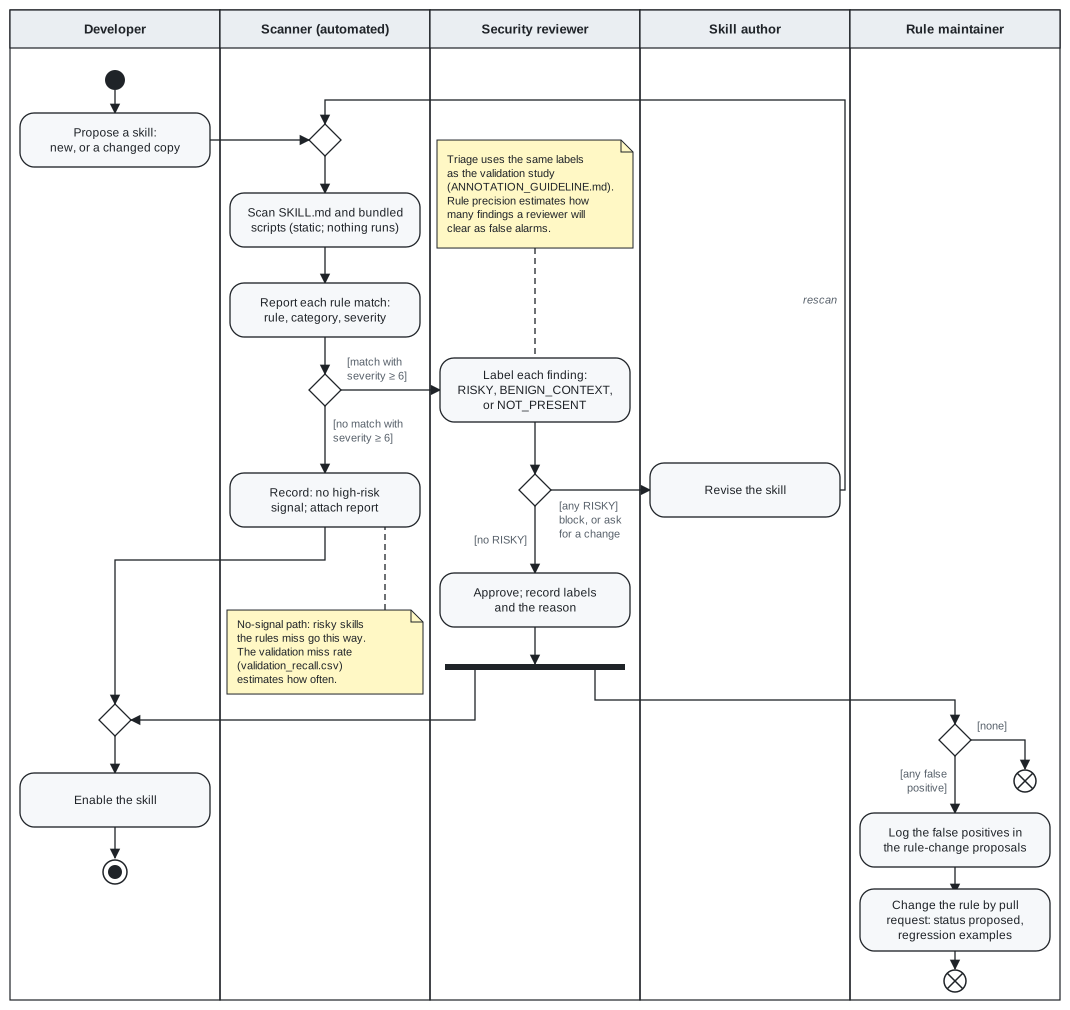
- The developer proposes a skill: a new one, or a changed copy of an existing one. A copy is scanned on its own; it does not inherit an earlier approval of a different copy. RQ3 shows why: copies of the same skill can differ in their high-risk categories (
results/rq3_summary.csv). - The scanner reads SKILL.md and the bundled scripts and reports every rule match with its rule, category, and severity.
- If no match has severity 6 or more (the threat model's "high risk"), the scan report is recorded and the skill can be enabled. This path is where the scanner's misses go.
- Otherwise the reviewer labels each high-risk finding RISKY, BENIGN_CONTEXT, or NOT_PRESENT.
- Any RISKY finding blocks the skill or sends it back to its author. The revised skill is scanned again.
- With no RISKY finding, the reviewer approves and records the labels and the reason. In parallel, any false positive (NOT_PRESENT, or BENIGN_CONTEXT that the rule could have told apart) goes to the rule maintainer, who logs it with
python scripts/annotation_kit.py proposals(docs/validation/RULE_CHANGE_PROPOSALS.md) and changes the rule by pull request with regression examples.
5. How the validation study measures this workflow
The triage labels are the validation labels, so the Sprint 2 validation numbers describe how this workflow would behave on the GitSkills sample.
| Validation result | What it says about the workflow |
|---|---|
Strict precision per rule and category (results/validation_precision_by_rule.csv, ..._by_category.csv) |
The share of findings a reviewer would label RISKY. One minus it is the share of the reviewer's time spent clearing false alarms |
Miss rate (results/validation_recall.csv) |
How often a risky skill takes the no-signal path in step 3 and is enabled without review |
Inter-rater kappa (results/validation_agreement.csv) |
Whether two reviewers given the same guideline reach the same decision, that is, whether triage depends on who does it |
Lineage precision and drift types (results/validation_lineage.csv, results/validation_drift.csv) |
Whether "copies of the same skill" are really related, and what kind of change made a copy's risk differ: the case for rescanning every copy in step 1 |
Severity sensitivity at cutoffs 5 and 7 (results/sensitivity_summary.csv) |
How the reviewer's load changes if the step 3 threshold moves |
None of these numbers exists yet; they come from python scripts/annotation_kit.py score after the round 1 labels are committed (docs/validation/README.md).
6. Not built, and open questions
- Not built: a command that scans one skill folder and prints a report; storage for reviewer decisions; any enforcement in an agent runtime. The batch pipeline (
python -m msr_pipeline analyze) is what exists. - Threshold. Step 3 uses severity 6. Is the reviewer's load at 6 acceptable, or should the threshold move, given the sensitivity results?
- Context rules. Rules below severity 6 (for example R-SHL-001, a shell code block) never reach the reviewer. Should the report still show them as context?
- Who reviews in a three-person team? The proposal above mirrors pull-request review: never the person who proposed the skill.